
Trail running has grown a lot in recent years. That’s great. More people running on trails means more people getting close to nature, discovering mountains, forests, parks, historic routes, and landscapes that might never have been accessed by road running.
But this growth also brings a challenge.
Many runners come to trail running with excellent physical fitness, training discipline, GPS watch, spreadsheets, specific shoes, and attention to performance. But they don’t always come with a formed outdoor culture. Many come from road running, where the environment is different, the rules are different, and environmental impact isn’t always as evident.
On an asphalt street, discarding a cup in a race area is bad, but normally there’s a cleaning crew right after. On a trail, a gel sachet, a piece of packaging, used toilet paper, a shortcut opened through vegetation, or poorly removed markings can remain for a long time, and the impact multiplies when hundreds or thousands of people repeat the same behavior.
Data released by UTMB World Series and Strava help measure this growth: in the first half of 2025, participation in races with UTMB Index was 2.4 times greater than in the same period of 2022, with more than 800 thousand starts in six months; 42% of these runners were participating in their first trail running race.
The problem, most of the time, isn’t ill intent. It’s lack of knowledge. And that’s precisely where Leave No Trace comes in.
Leave No Trace is not a list of rigid rules. It’s a framework of principles for reducing the impact of our outdoor activities. These principles can be applied in different environments and activities, from remote areas to urban parks, and serve as a simple foundation to guide more responsible choices.
In trail running, the principles are the same. What changes is how to apply them.

Illustrative image generated by artificial intelligence
According to Gabriela Corrêa, head of brand at WTR, implementing minimum impact practices in trail running races is essential because the activity happens precisely in natural environments, often in sensitive areas of great environmental value and difficult access.
“Every operational choice matters: what we deliver in the kit, how hydration stations work, how waste is separated, how suppliers are guided, and even how the trail is prepared before and after the race. WTR already structures its actions with a focus on environmental education, waste management, trail conservation, and local partnerships,” she explains.

Principle 1 — Plan ahead and prepare
In trail running, this means: planning goes beyond pace, elevation gain, hydration, and race strategy.
Running on trails requires physical preparation, but also environmental and technical preparation. The athlete needs to know the course, understand the terrain type, assess the weather forecast, know if there will be cell signal, upload a reliable route, know how to use the GPS watch or navigation app, and notify someone about your plan when training alone.
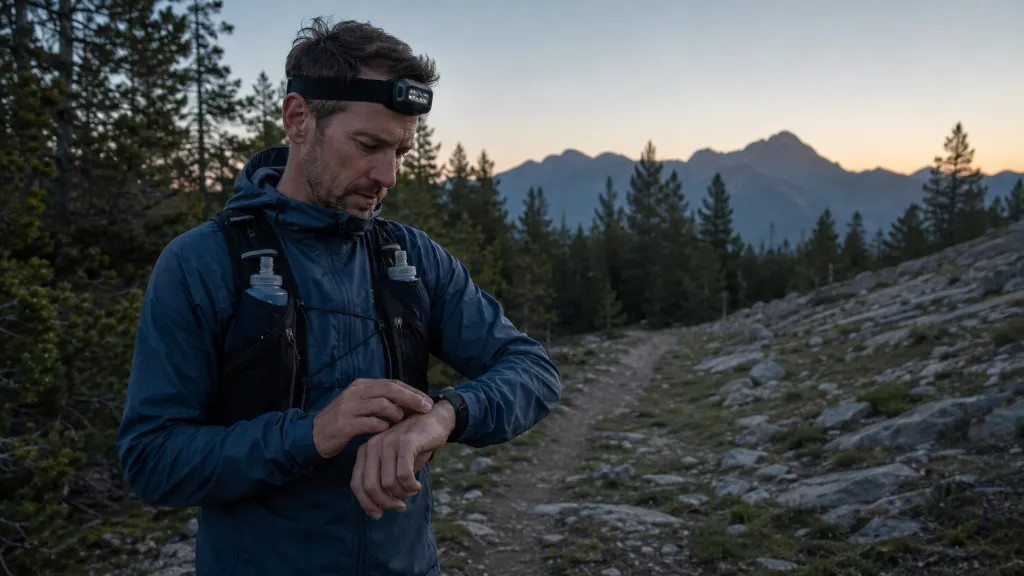
Illustrative image generated by artificial intelligence
A trail run can take a person far from their car, home, a road, or any point with cell signal. In case of navigation error, fall, twist, hypothermia, dehydration, or delay, what seemed like a simple workout can turn into a rescue situation.
And rescues also generate impact. They mobilize people, vehicles, teams, movements off trail, and pressure on natural areas. The priority will always be saving lives, but the best way to reduce that impact is to prevent foreseeable situations from happening.
Planning, therefore, is also a minimum impact practice.
For organizers, this principle begins before registration opens. A race needs to have an authorized course, risk analysis, emergency plan, clear communication with athletes, information about mandatory equipment, guidance on hydration, support stations, waste disposal, bathrooms, and environmental conduct.
Principle 2 — Travel and camp on durable surfaces
In trail running, this means: run on the trail, stay on it, and do not create new trails.
This is one of the most important principles for runners, and where we observe a lot of impact happening.
In the context of trail running, “durable surfaces” are mainly existing trails, dirt roads, rock, gravel, and other places capable of receiving passage without increasing impact. The rule of thumb is simple: if a consolidated trail exists, stay on it.
This means not cutting corners on curves, not opening a second line to pass, not going around mud by stepping on side vegetation, not leaving the route to gain a few seconds, and not turning a congested section into an excuse to create a path where none exists.
Leave No Trace recommends that runners go through wet sections, puddles, and obstacles instead of going around them, precisely to avoid creating new trails and damaging side vegetation. It also advises choosing another route when the trail is excessively muddy and needs time to recover.
This may seem counterintuitive. The runner’s natural tendency is to avoid mud to not get their shoes wet, not slip, not lose pace, or not dirty their gear. But from a minimum impact perspective, often the right approach is to accept the trail as it is.
When hundreds of runners avoid the same puddle or muddy section, the trail widens. Vegetation is trampled, soil becomes exposed, water starts flowing through new paths, and the erosion process accelerates. What was a small individual decision becomes a collective problem.

Illustrative image generated by artificial intelligence
For organizers, this principle is even more sensitive. A race course must respect existing trails, sensitive areas, conservation unit rules, local communities, buffer zones, and the environment’s carrying capacity. Opening trails without authorization, passing through fragile areas, or placing athletes in locations that should not receive that flow is not just a technical error. It is a violation of the sport’s ethics.
A recent case in Brazil shows that this debate is not theoretical. In May 2025, the State Environmental Institute of Rio de Janeiro (INEA) fined the Transmantiqueira Ultra Trail Agulhas Negras, TUTAN, held in Resende, for illegal deforestation and environmental crimes against the Atlantic Forest. The race would have occurred without INEA environmental authorization and involved clandestine trail opening, with approximately 615 meters of deforestation within Pedra Selada State Park and another 260 meters in the unit’s buffer zone. Among the damages noted were soil compaction, erosion, alteration of natural drainage, intervention in an area with slopes exceeding 45°, and impact on the açai palm (Euterpe edulis).
Cases like this need to serve as a warning.
The runner is not responsible for all of an organization’s decisions. But by registering, promoting, starting, posting photos, and celebrating a race, he helps legitimize that event. That’s why choosing where to run well is also part of a minimum impact ethic.
Before registering, it’s worth asking: does the race have authorization from the area’s managers? Does the course use existing trails? Does the organization explain its environmental practices? Is there a waste management plan? Will signage be removed after the race? Are there bathrooms at the start, finish, and strategic points? Does the number of participants seem compatible with the location? Does the race contribute to trail maintenance, conservation units, or local communities?
The athlete does not just choose where he will run. He chooses what kind of trail running culture he wants to help build.
Principle 3 — Properly dispose of waste
In trail running, this means: everything you take on the trail needs to come back with you, including small trash, used toilet paper, and feces.
When talking about Leave No Trace on trail running, the first image that usually comes to mind is a gel sachet thrown on the trail. And indeed, that is a problem.
But the impact is not just in the obvious trash. It’s also in the torn tip of the sachet, the seal, the little piece of protein bar wrapper, the salt capsule, the napkin from the aid station, the gummy wrapper, and every micro-trash that can fall without the athlete noticing.
Leave No Trace emphasizes that many runners don’t leave trash on purpose, but that it’s easy to lose small residues during a run. That’s why it recommends that the athlete have a plan before heading out: a specific pocket, a resealable bag, a ziplock, a reusable flask, or another secure system to store wrappers and waste.
On trail runs, this needs to be thought through realistically. The athlete may be tired, wearing gloves, running in the dark, cold, in the rain, or trying to open a gel on a technical downhill. If there’s no simple system in place, the chance of something falling increases.
I remember that when I did El Cruce in 2022, the organization prohibited the use of gel sachets, which forced runners to transfer the gel into bottles before the race.

The rule is simple: if you brought it full, you can bring it back empty.
Human waste is also trash
This point needs to be stated clearly: runners may also need to use the bathroom in the middle of a workout or a race.
It’s not a pleasant topic, but it’s a necessary one. Anyone can feel the need to defecate during a long run, an ultramarathon, a workout in a remote location, or a race that lasts many hours. That’s why the runner needs to have thought beforehand about what to do.
The classic Leave No Trace guideline, when the location allows, is to bury feces in an appropriate hole, known as a cathole, far from trails, campsites, and water sources. But this requires appropriate soil, sufficient distance, a digging tool, privacy, time, and knowledge. In many trail running situations, especially in races, this simply isn’t realistic.
On heavily used trails, sensitive areas, rocky terrain, protected areas, places where digging is not permitted, or races with heavy athlete traffic, the most responsible approach is to bring everything back in a system designed for human waste.
In trekking, there are already solutions designed for this, such as the Gaia Adventure Portable Waste Container, which allows you to transport waste more safely and discreetly. For runners, this type of solution may be too large, but it serves as inspiration: what matters is that the athlete has a previously planned system that is durable, well-sealed, and separate from other items in their vest or backpack.
In simpler situations, a reinforced ziplock or a small waterproof bag can fulfill part of this function, especially for transporting used toilet paper. But, when the need involves human feces, the ideal is to consider systems specifically designed for human waste, with secure closure and, when possible, absorbent or neutralizing material, such as WAG Bags or similar solutions.
Unfortunately, these products are still not easily found in many countries. For those traveling to the United States, for example, it may be worth buying a few units and keeping them in your backpack or vest as an emergency item for long training sessions, quick traverses, or races in sensitive areas.
The main point is that this needs to be planned beforehand. Just as a runner thinks about gel, water, windbreaker, lighting, and navigation, they also need to think about what they’ll do if they need to defecate during the race.
It’s not a minor detail. Human waste is also a residue. And, in many environments, leaving it on the trail, even buried, can contaminate the soil, impact waterways, degrade the experience of other users, and create a management problem for the natural area.
In other words: it’s not enough to think about gel, water, and shoes. You also need to think about poop.
Races without disposable cups
Waste reduction also extends to aid stations.
Many trail running races have already stopped offering disposable plastic cups. This reduces trash generation and educates the athlete to take on part of the responsibility for their own hydration.
In Brazil, WTR is a good example. In the race manual, the organization informs that it does not provide disposable cups, that all athletes receive a collapsible silicone cup in their kit, and that, for certain distances, it’s mandatory to start with a hydration container. The same material presents waste management practices, Zero Waste goal, trail cleaning before, during, and after the race, donation of sports materials, and other sustainability initiatives.
For the runner, this means leaving home prepared. It could be with a soft flask, bottle, hydration system, cup provided by the race, or an ultralight collapsible cup. An example is the Curn Collapsible Cup, by CNOC Outdoors, a flexible 250 ml cup, compact and collapsible that weighs about 11 g, designed for runners and outdoor activity enthusiasts who need a lightweight solution for drinking at water points or mixing hydration tablets.
The most important thing is not the cup model. It’s the change in mindset. Instead of waiting for the race to provide everything, the athlete becomes part of the solution.
“When we don’t offer disposable cups at hydration stations and we provide a collapsible cup in the kit, the runner stops being just a spectator of a sustainable message and becomes part of it. They need to prepare themselves, bring their own container, think about their own hydration, and understand that their presence in that environment also involves responsibility,” explains Gabriela.
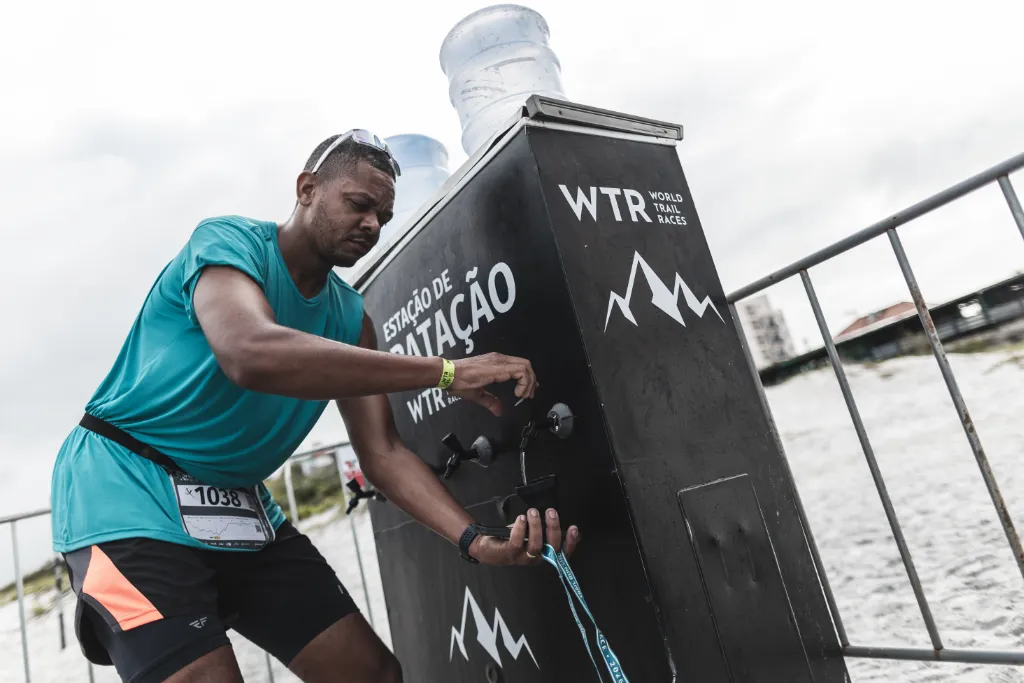
For her, this change in behavior promotes education in a practical way. “The athlete realizes that small individual decisions, when applied at scale, significantly reduce the event’s impact”.
During one of the WTR stages, research was conducted showing that 94.2% of the audience noticed some of the good practices implemented, and 33% specifically mentioned the fact that disposable cups were not provided.
Principle 4 — Leave What You Find
In trail running, this means:
not taking natural souvenirs, not altering the trail, and not turning the environment into a disposable scenery.
This principle may seem less obvious to runners, but it appears in many details.
Do not pick flowers, fruits, seeds, or plants. Do not take stones, shells, bones, feathers, or other natural elements as souvenirs. Do not disturb historical or cultural structures. Do not remove official signs. Do not build cairns, improvised arrows, or stone markers. Do not “improve” the trail on your own during a workout. Do not create passages through vegetation to ease a descent or pass another runner.

Illustrative image generated by artificial intelligence
It’s also worth thinking about the digital world.
Not every trail recorded on GPS should become an invitation for repetition. In some places, sharing tracklogs of informal accesses, shortcuts, unauthorized trails, or sensitive areas can increase impact. Route apps, segments, and social networks are powerful tools, but they can also popularize paths that shouldn’t receive traffic.
For organizers, “leave what you find” means removing everything that was placed for the event: tape, signs, arrows, banners, temporary structures, arena materials, ground markings, and waste from aid stations. Signage should be temporary, removable, and planned to leave no permanent marks.
“When an event takes place on a mountain, a trail, a beach, or a conservation area, there is a very large responsibility to preserve that territory and to return that space as well cared for as possible,” Gabriela comments.
Therefore, a well-organized event should not leave traces on the trail.
Principle 5 — Minimize Campfire Impacts
In trail running, this means: controlling any heat source associated with training, the event, or the event structure, especially in dry or sensitive areas.
For those just running, this principle may seem distant. After all, runners don’t usually make campfires during a workout or event. But the logic behind the principle remains very relevant: avoiding damage caused by fire and other heat sources in natural environments.
In trail running, this impact can appear in other ways. Some events involve a start and finish area, support bases, gathering areas, camping, overnight stays, teams, staff, volunteers, spectators, and on-site food service. In longer events, there may also be support kitchens, use of camp stoves, grills, generators, lighting, heaters, or temporary structures.
Additionally, there is the risk of fire. Cigarette butts, poorly used camp stoves, improvised grills, unauthorized campfires, sparks, improperly extinguished embers, or any heat source during dry periods can cause enormous damage. In some regions, a small act of negligence can cause a large-scale forest fire.
For athletes, the application is simple: do not make improvised campfires, do not discard cigarette butts, respect local restrictions, avoid any unauthorized source of fire, and guide support teams, family members, and friends to do the same. Even those just accompanying an event are part of that event’s impact.
For organizers, this principle requires arena planning, control of food areas, clear camping rules and support teams, guidance for volunteers and spectators, compliance with local regulations and special attention during dry seasons or high fire risk periods. When there is kitchen use, camp stoves, grills or generators, this needs to be planned, authorized and controlled.
In other words, in trail running, Principle 5 is not limited to the traditional campfire. It addresses a broader question: what risks and impacts can heat sources associated with the activity generate in that environment?
Even when the runner doesn’t camp, the race can create a structure around the trail. And that structure also needs to follow a minimum impact logic.
Principle 6 — Respect Wildlife
In trail running, this means: running without chasing, startling, feeding or interfering with animal behavior.
Runners move quickly, often in relative silence, early in the morning, late in the afternoon or at night. This increases the chance of unexpected encounters with animals.
For this reason, it’s important to observe wildlife from a distance, not chase animals to photograph them, not attempt to touch them, not feed them, not leave food scraps and reduce unnecessary noise in sensitive areas.

Illustrative image generated by artificial intelligence
It’s also important to respect temporary trail closures due to breeding, nesting, presence of young animals, fire risk or environmental recovery. A closed trail is not a challenge for the “hardcore” athlete. It’s a management decision that must be respected.
Food scraps also fall into this category. A fruit peel, a piece of a bar or food left on the ground is not harmless. It can attract animals, alter behaviors and create an association between human presence and food.
For organizers, this principle involves route selection, timing of year, communication with managers, noise reduction in sensitive areas, garbage control at aid stations and clear guidance to athletes.
Principle 7 — Be Considerate of Others
In trail running, this means: remembering that the trail doesn’t belong only to runners.
The trail can be used by hikers, families, guides, pilgrims, cyclists, horseback riders, local residents, researchers, firefighters, park rangers and other runners. In a race, an athlete may have a bib number, a timing chip and a finish time goal. But that doesn’t turn the trail into an exclusive track.
Leave No Trace recommends that runners communicate their presence, ask for passage politely, wait for a safe place to pass, respect those who are climbing and pay special attention to horses and other trail users.
In practice, this means reducing speed when necessary, not startling people from behind, avoiding loud headphones, respecting shared trails and accepting that losing a few seconds is part of healthier coexistence.
Performance does not justify rudeness. Competition does not eliminate respect.

Illustrative image generated by artificial intelligence
For organizers, being considerate of others means engaging in dialogue with local communities, notifying regular users of the area, avoiding blocking access without communication, respecting residents, guiding staff and athletes, taking care of traffic, noise, parking, and the relationship with those who live or work in that territory.
A trail run race doesn’t happen just in a landscape. It happens in a place. And places have histories, rules, communities, other uses, and other people.
A race can also educate
When a race seriously incorporates Leave No Trace principles, it ceases to be just a sporting event. It becomes an educational opportunity.
This can appear in the athlete’s manual, in the technical briefing, on social media, at support stations, on temporary signs, and in the training of staff and volunteers. Simple messages can make a big difference:
“Stay on the trail.”
“Go through the mud, not through the vegetation.”
“Take your gel back.”
“Respect wildlife.”
“Don’t cut corners.”
“Your trash finishes the race with you.”
The International Trail Running Association (ITRA) presents its Green Charter as an initiative to mobilize the trail running community in reducing the environmental impact of the sport, emphasizing that this responsibility involves organizers, participants, volunteers, sponsors, suppliers, and partners.
Running lighter also means leaving less impact
In trail running, there’s a lot of talk about running light. Lighter shoes, smaller backpacks, carbon poles, compact jackets, flexible bottles. Less weight, more speed, more efficiency.
But there’s another kind of lightness.
Running light also means passing through a trail without widening it. It’s carrying back everything that was brought in. It’s having a plan for your own waste, including human waste. It’s not cutting corners, knowing when to wait to pass, and choosing races that respect the places they go through.
It’s understanding that nature is not an obstacle, scenery, or disposable product.
Trail running only exists because there are trails, mountains, forests, parks, communities, and landscapes capable of welcoming us. If the sport grows without care, it compromises precisely what makes it special.
Chico Santos, an elite trail running athlete and coach, trained in Leave No Trace – Level 1 Instructor, often uses the phrase “The more people on the trail, the more trail in us”. And feeling part of nature comes through education, respect, and awareness.
Organizer of Training Camps through CS Experience, Chico’s goal is to include Leave No Trace workshops to expand knowledge about minimum impact techniques among trail runners.
“Although many trail running practitioners are aware, there are still irregular practices, mainly the habit of leaving small trash along the way. It’s important to share information, especially with those just starting out, so they begin with this awareness.”
Beyond spreading knowledge at his events, Chico disseminates Leave No Trace principles through his social project. “I coach three athletes who are already standing out, and I work with them on raising awareness about the importance of not deviating from the route to save time or avoid obstacles, as well as respect for other runners.”
In trail running, Leave No Trace doesn’t limit the experience. On the contrary: it helps ensure that it continues to exist.
Want to learn more about Leave No Trace?
Gear Tips is a corporate partner of Leave No Trace and works on spreading minimum impact principles through articles, videos, courses, and educational materials aimed at practitioners, guides, conductors, instructors, event organizers, and outdoor industry professionals.
To continue learning, access the content about Leave No Trace on the Gear Tips blog!
Those who wish to go even deeper can take the Leave No Trace – Level 1 Instructor course, part of Gear Tips’ CAPACITAR Program. The course trains multipliers capable of teaching minimum impact practices through lectures, workshops, introductory courses, educational activities, and actions in parks, schools, clubs, tour operators, and outdoor communities.
Leave No Trace is not just about not leaving trash. It’s about developing a more conscious, responsible, and respectful relationship with the places we visit.