
Choosing a backpack for trekking may seem like something trivial, but there are some very important factors that need to be taken into consideration to ensure the choice is adequate.
In this article, I will show you how to choose the ideal backpack for your trekking, explaining the types of hikes, the factors that influence this choice, and the main deuter models for different practitioner profiles.
Understanding outdoor activities
When we look at a mountain range, we can be surprised by the diversity of activities that happen simultaneously in the same natural environment. The image below — frequently used in my courses and presentations — illustrates this clearly:
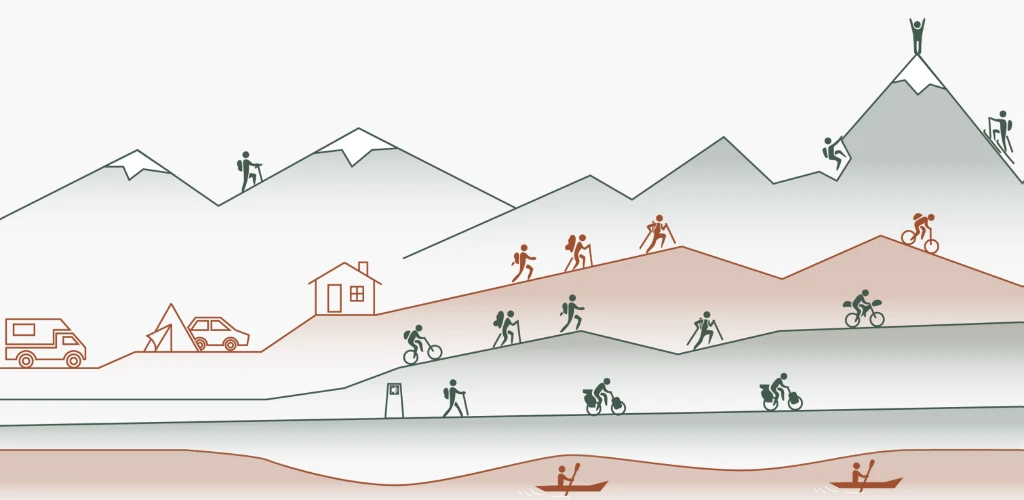
In the same location, such as the first mountain in the illustration, we find:
- A cyclist doing a one-day activity or mountain bike crossing with a specific backpack for cycling with autonomy;
- A person doing a traditional trekking, with a larger and heavier cargo backpack;
- A person doing a day hike or an ultralight trekking, with a reduced backpack and, in the case of ultralight trekking, with minimalist equipment;
- A person practicing trail running, with a small and lightweight backpack, designed for performance;
- Cyclists doing bikepacking or traditional bike touring.
The environment is the same. What changes are the choices: type of activity, duration, level of self-sufficiency, type of accommodation, volume and weight of equipment — and, consequently, the ideal backpack for each situation.
Similar equipment, different needs
Although the activities are distinct, there is a common point between them: the need to carry equipment. Whether running, hiking, or cycling, everyone carries some type of backpack or cargo transport system. However, these systems vary greatly depending on the type of activity:
- Trail running backpacks prioritize lightness, body fit, and quick access to hydration and nutrition;
- Traditional trekking backpacks focus on load capacity, comfort (load transfer), and durability;
- The ultralight trekking backpacks focus on minimalism and lightness;
- The cycle touring panniers are designed to not compromise the bike’s stability, just as bikepacking bags are designed to improve aerodynamics and mobility.
Despite the initial examples being from different outdoor activities, in this article I will focus only on trekking backpacks.
Technical choice: the right backpack for each activity
Specialized brands, such as deuter, which has accumulated over 125 years of tradition, develop backpacks specific to each type of outdoor activity.
The following images show how deuter segments its product line according to these activities. It is possible to observe the wide variety of available models — not counting the variations within each category!
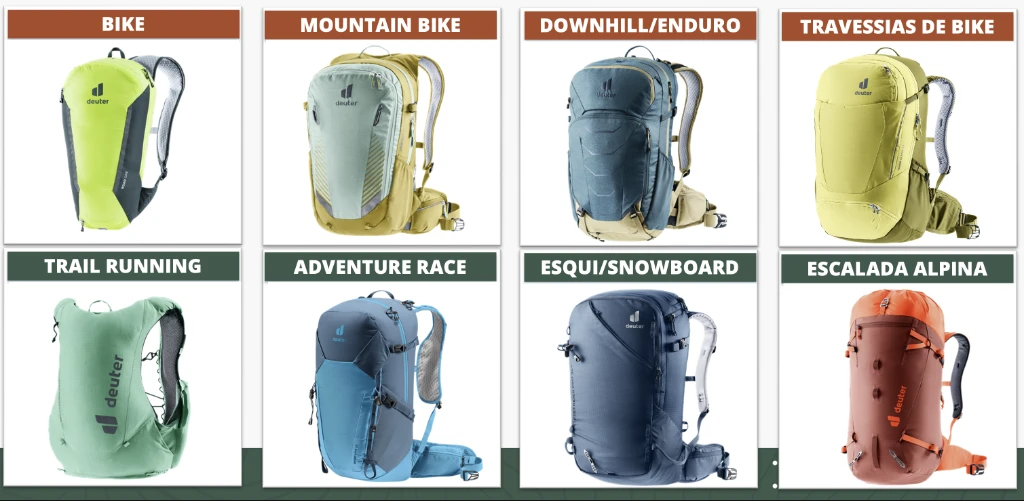
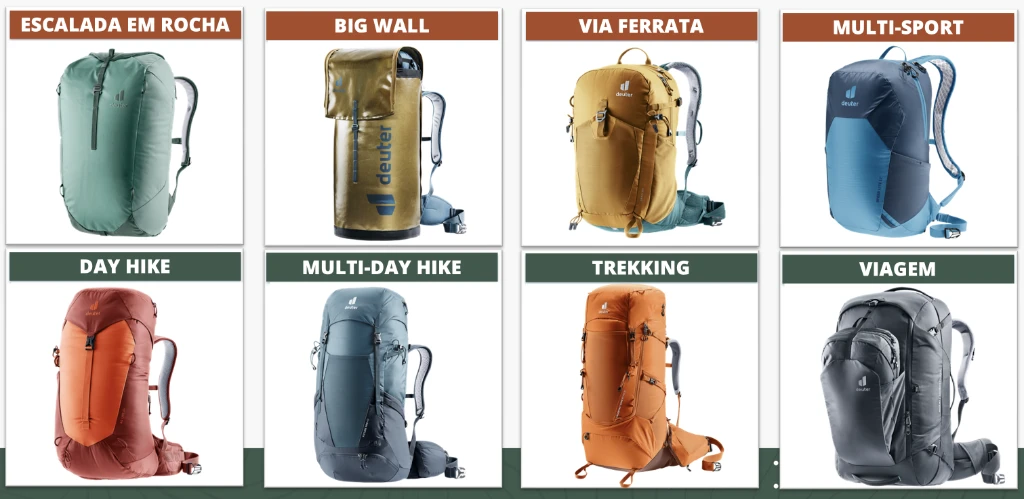
This specialization allows practitioners to have more comfort, efficiency, and safety when using a backpack designed specifically for the activity they practice.
Climate, altitude, and season: essential factors in choosing a backpack
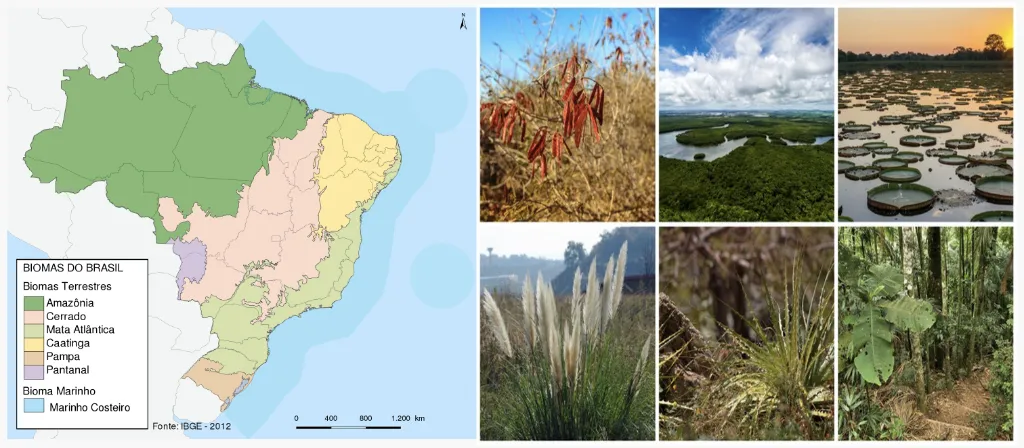
As seen previously, the same natural environment — such as a traverse through a mountain range — can host different outdoor activities. But there is another crucial point to consider: the climatic conditions and time of year.
In the same geographic location, conditions can vary greatly. A trek carried out in summer, with dry weather and mild temperatures, will require fewer clothes (or lighter clothing) and a lighter and more compact sleeping system. The same traverse in winter, however, can demand bulkier cold-weather clothing, sleeping bags rated for lower temperature ranges, and extra accessories to withstand intense cold — thus requiring a backpack with greater volume and load capacity.
When we expand the analysis to different environments, another decisive factor comes into play: altitude. Activities in high mountains, such as climbing Aconcagua or Denali, require more specific equipment to withstand the extreme environment. Therefore, heavier, bulkier, and more technical gear, which directly impacts the choice of backpack that will carry them.
In other words, beyond the type of activity, climate, biome, altitude, and season are determining factors for choosing the ideal backpack for each situation.
Hiking vs. Trekking: what’s the difference?
To be able to choose the appropriate backpack for a trek, we need to better understand some concepts. Among them, what types of outdoor walking exist.
When we talk about hikes, a variety of terms emerge: hiking, trekking, backpacking, thru-hiking, randonnée, bushwalking, among others. The confusion is understandable, as nomenclature varies from country to country — and even among practitioners.
For working with European brands like deuter since 2001, I adopted here the European concept, which clearly distinguishes two major groups:
- Hiking
- Trekking
The central difference: sleeping in a shelter or camping
The main distinction between hiking and trekking lies in self-sufficiency and overnight stays:
- Hiking: hikes performed without the need for camping. They can be day hikes – such as a hike in Tijuca Forest (RJ) –, or multi-day hikes, such as the Camino de Santiago de Compostela, where we sleep in hostels.
- Trekking: hikes of two or more days with overnight camping, requiring that the practitioner carry shelter, sleeping, and cooking systems, among others.
Trekking – the focus of this article
How trekking is characterized by being a hike with overnight camping, lasting two or more days, the practitioner must be self-sufficient. They must carry their shelter system (tent or tarp or hammock, etc.), sleeping system (sleeping bag, thermal insulation, etc.), kitchen system (stove, pot, etc.) and other items.
Trekking can be practiced in different styles, classified according to the base weight — a topic we will address further ahead.
A didactic example: Petrópolis to Teresópolis Crossing
The classic crossing in Serra dos Órgãos National Park (RJ) is an excellent example of the variety of approaches:
Trail Run: Crossing done running in 1 day, with a light backpack;
Day Hike: Hike in 1 day, leaving early and arriving the same day;
Multi-day Hike: Hike in 3 days, sleeping in the park’s shelters;
Trekking: Hike in 3 days, with camping at designated points.
This example shows how the same crossing can be experienced in completely different ways, and each one will require a backpack with specific characteristics.
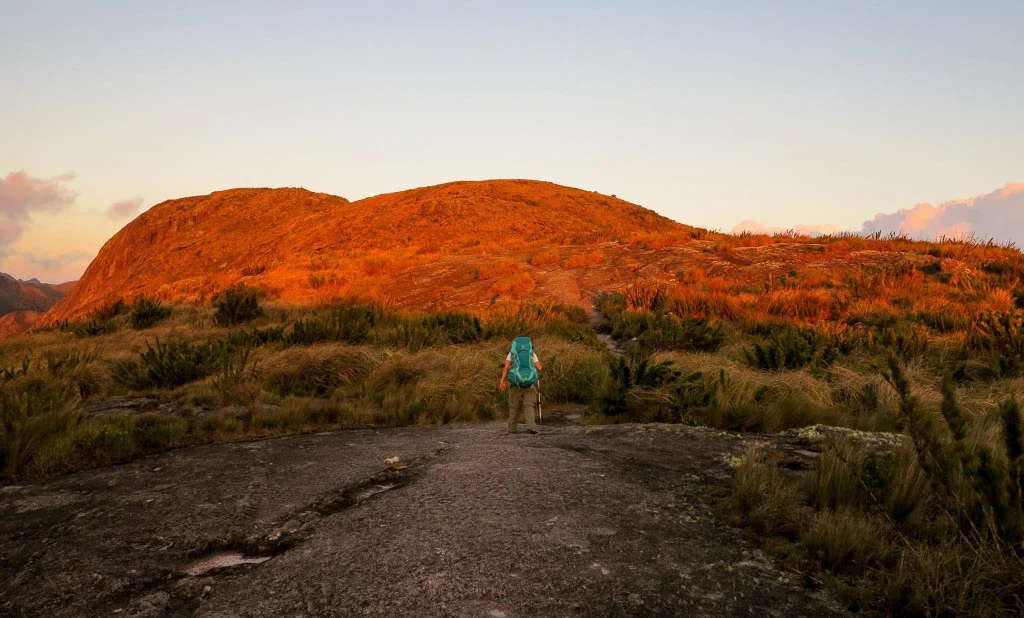
Petrópolis-Teresópolis Crossing – Photo: Mario Nery
Types of trekking: classification by base weight
The base weight is everything that is in the backpack, excluding consumables (food, water, and fuel). The classification of trekking types based on base weight is as follows:
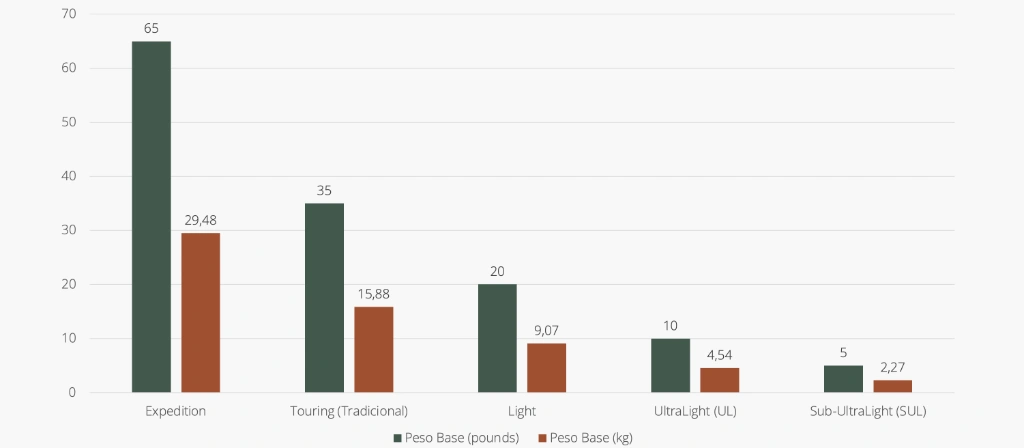
The lighter the gear, the smaller the backpack can be — but it is essential to maintain safety (and comfort, as much as possible), especially in cold climates.
It’s worth noting that, in the graph above, I included weights in pounds, as this classification was made in the USA and, to make it easier, I added the conversion to kg.
Backpack Classification by Volume
Traditionally, in Brazil, backpacks are divided into:
- Attack Packs: up to 35 liters
- Semi-Cargo Packs: between 35 and 50 liters
- Cargo Packs: over 50 liters
With the popularization of ultralight trekking (UL), backpacks with the volume of attack packs started to be used in self-sufficient treks as well — as long as the equipment is light and compact.
How to Choose Your Trekking Backpack
Now that it’s clearer why there are so many types of backpacks for different activities, styles, and contexts, we get to the central point of this article: how to choose the ideal backpack for your trekking.
One of the most common mistakes made by those just starting out (and even by experienced practitioners) is starting from the end: choosing the backpack before defining the rest of the gear. But the correct process is exactly the opposite.
The backpack is not a starting point, but rather a final answer to a series of previous decisions. After all, it’s impossible to know which backpack you need without first knowing the volume and weight of everything you will carry: tent, sleeping bag, clothes, cooking utensils, food, water, and fuel.
That’s why the first step is to size the contents of your backpack — and this includes both the base weight (gear inside the backpack) and consumables (items that will be used over time, such as food and water). Even a light base weight can be accompanied by a significant volume of consumables, depending on the duration and characteristics of the trail, which will require a larger backpack with greater load capacity.
Load capacity vs. volume
When choosing a backpack, two main factors should be taken into account:
-
- Internal volume (in liters): defines the total space available to organize and store items.
Attention: Some brands, mainly ultralight trekking ones, consider the total volume including external mesh pockets.
- Load capacity (in kg): indicates the maximum weight the backpack can carry comfortably, and not just how much it can “handle” structurally.
Here comes an essential point: load capacity (and consequently comfort) is not about backpack durability, but rather about ergonomics. A good trekking backpack transfers most of the weight to the hips through the load transfer system (straps, back panel, and hip belt), relieving the shoulder load. This efficient transfer can reach 70% or even 80% of the total weight, reducing fatigue and preventing pain — what we call perceived weight reduction. Perceived weight is the weight we feel on our shoulders.
On the other hand, there are those who prefer lighter backpacks with minimal structure, even if it means carrying more weight on their shoulders. This choice is valid — as long as it is conscious and in accordance with the trekking style and the practitioner’s physical limits.
Checklist: how to choose your trekking backpack
- Define the activity you will perform (hiking, multi-day hike, or self-sufficient trekking);
- Analyze the scenario: where you’re going, what biome, climate, altitude, and season;
- Choose the right equipment according to that scenario (shelter, clothing, sleep system, etc.);
- Plan your meals and define the appropriate cooking system (stove, pot, fuel);
- Calculate your base weight: weigh or research the weight of your gear if you don’t already own it;
- Estimate consumables: water, food, and fuel needed for your trail days;
- With this data in hand, select backpacks with volume and load capacity that match your needs;
- Finally, refine your choice based on the features you value (hip belt pockets, front opening, bottom access, hydration system, trekking pole/stake attachment, etc.).
deuter backpacks for trekking
Although there are countless backpack brands in Brazil and around the world, I present in this article the deuter backpacks. Because it’s a brand with several models, we’re able to make educational comparisons between different backpacks based on volume, load capacity, and type of use.
deuter offers backpacks with different weights, volumes, and load capacities — that is, the ideal weight that the backpack was designed to carry comfortably. Below, see the main models recommended for trekking (including backpacks traditionally seen as “day packs,” but that fit within the ultralight trekking logic):

Aircontact PRO
- Load Capacity: up to 66 lbs
- Sizes: 65+10 SL up to 85+10 liters
- Weight (Aircontact PRO 75+10): 2.920 g
- Trekking Type: expedition
- Recommendation: mountain guides, self-sufficient expeditions
Highlights:
- Structured backpanel with VariSlide adjustment
- VariFlex hip belt with expandable zipper and retractable bottle holder
- Removable top lid that converts to attack pack
- Full front access, expandable pockets, rain cover included
Watch the video: All about the Deuter Aircontact PRO.
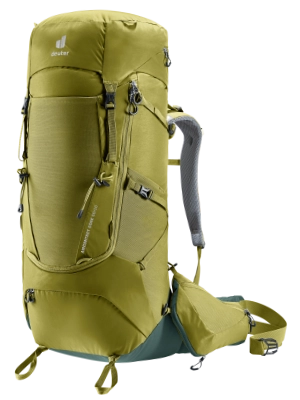
Aircontact Core
- Load Capacity: up to 20 kg
- Sizes: 35+10 SL up to 70+10 liters
- Weight (Aircontact Core 60+10): 2.310 g
- Trekking Type: traditional
- Recommendation: mountain guides, self-sufficient expeditions
Highlights:
- VariSlide hip belt adjustment
- Large pockets on hip belt
- Retractable water bottle carrier on hip belt (larger sizes)
- J-shaped front zipper access
- Rain cover included
Watch the video: All about the Deuter Aircontact Core.
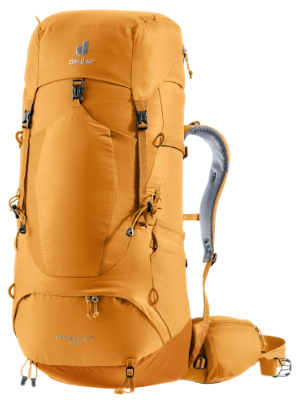
Aircontact Lite
- Load Capacity: up to 15 kg
- Sizes: 35+10 SL to 50+10 liters
- Weight (Aircontact Lite 50+10): 1.640 g
- Trekking Type: light
- Intended Use: crossings with more compact equipment
Highlights:
- Aircontact back panel with central ventilation
- Lightweight frame with VariQuick adjustment
- Internal divider and expandable pockets
- Compatible with hydration system
- Rain cover not included
Watch the video: All about the Deuter Aircontact Lite.
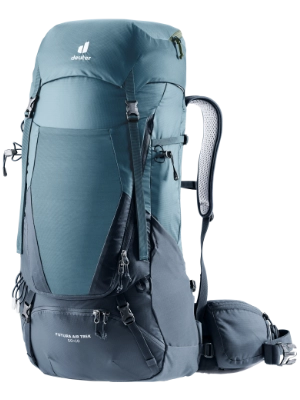
Futura Air Trek
- Load Capacity: up to 33 lbs
- Sizes: 45+10 SL to 60+10 liters
- Weight (Futura Air Trek 50+10): 2.050 g
- Trekking Type: light
- Recommendation: trekking in hot or humid climates
Highlights:
- Aircomfort side panel with high ventilation
- VariSlide adjustment for different torso sizes
- Large front and side pockets
- Front zipper access
- Rain cover included
- Ideal for those who perspire heavily
Watch the video: All about the Deuter Futura Air Trek.
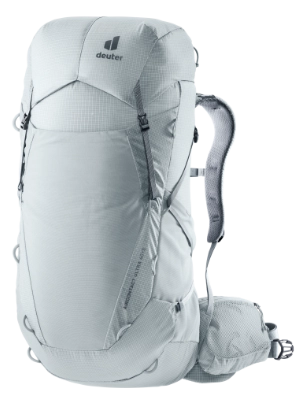
Aircontact Ultra (35+5 SL to 50+5)
- Load Capacity: up to 12 kg
- Sizes: 35+5 SL to 50+5 liters
- Weight (Aircontact Ultra 40+5): 1.190 g
- Trekking Type: ultralight
- Recommended For: ultralight trekking, Camino de Santiago, multiday hikes
Highlights:
- Back panel with Air Spacer mesh and Clip & Loop adjustment
- Removable cover and straps to reduce weight
- Multiple external loops for equipment attachment
- Lightweight yet durable frame
- Compatible with hydration system
- Rain cover not included
Watch the video: All about the Deuter Aircontact Ultra.
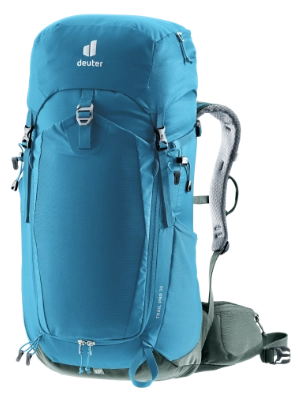
Trail PRO
- Load Capacity: up to 12-15 kg
- Sizes: 34 SL to 36 liters
- Weight (Trail PRO 36): 1.530 g
- Trekking Type: light / technical
- Recommendation: short treks, via ferrata, technical climbing
Highlights:
- Airstripes back panel with ventilation and good stability
- Compact structure with good front access
- Side pockets with zipper and stretch
- Ice axe support, via ferrata system and hydration system
- Rain cover included
Watch the video: Everything about the Deuter Trail PRO.
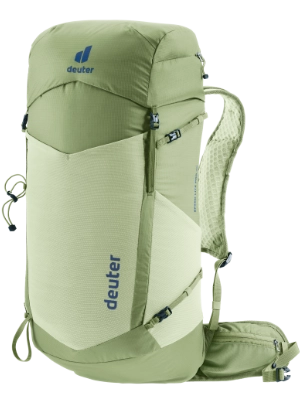
Speed Lite PRO
- Load Capacity: up to 6–10 kg
- Sizes: 28 SL and 30 liters
- Weight (Speed Lite PRO 30): 760 g
- Trekking Type: ultralight / fast & light
- Recommendation: quick traverses with minimal gear, speed hiking
Highlights:
- LiteAir back panel with ventilation and lightweight design
- Vest-style straps with soft flask pocket
- Trekking pole and ice axe attachments (1 side)
- Well-distributed internal and external compartments
- Compatible with hydration system
Watch the video: Checklist for light trekking with the Speed Lite PRO.
Conclusion: a technical choice aligned with your journey
Choosing the ideal backpack for your trekking is not an isolated decision — it’s the result of deeply understanding the type of activity you’ll perform, the equipment you’ll use, and the challenges of the natural environment you’ll face. Volume and load capacity are just numbers if they’re not aligned with your style, goals, and real needs.
By understanding the logic behind backpack categories, different types of trekking, and terrain conditions, you start making more conscious decisions — that directly impact the comfort, safety, and pleasure of your journey.
And if you want to dive even deeper into this topic, I recommend watching our exclusive live “Trekking and the Ideal Backpack for Every Journey”, available on Gear Tips Plus. In the video, I show the different backpack styles, share real field experiences, and answer common questions from those just starting out — or already advancing in their outdoor activities.
Happy trails — and may your backpack always serve your journey, never against it.